
What to Know Before You Play Padel: A Quick Beginner's Guide
Padel is doubles on a small, glass-walled court, played with a solid paddle and an underhand serve. If you've played tennis or pickleball, you can learn the basics in one session. Here's what to know before you step on court.
1. Scoring: just like tennis
Padel uses tennis scoring, so if you know tennis, you already know this part.
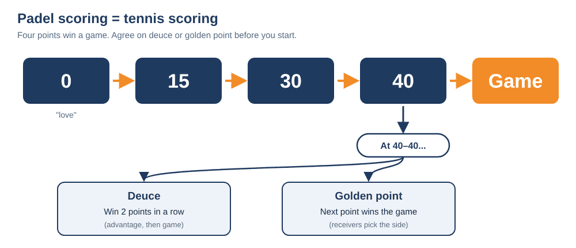
- Points: 0 (love), 15, 30, 40, game.
- Deuce: At 40–40, you need two points in a row to win the game (advantage, then game).
- Golden point: Many clubs and pro events skip advantage. At 40–40, the next point wins the game, and the receiving team picks which side receives. Agree on this before you start.
- Sets: First to 6 games, winning by 2. At 6–6, play a tiebreak to 7 points.
- Match: Usually best of 3 sets.
- Switching sides: Change ends after the first game, then every two games (on odd-numbered games).
2. How to serve
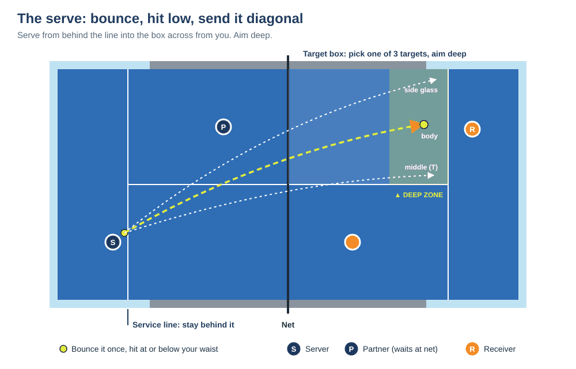
The padel serve is underhand: bounce the ball, hit it at or below your waist, and send it diagonally into your opponent's service box.
The rules
- Bounce the ball once behind the service line before you hit it.
- Contact must be at or below your waist.
- Keep your feet behind the service line and don't walk, run or jump.
- Serve cross-court. Start on the right side, then alternate each point.
- The ball must land in the box. After it bounces, it can hit the glass but not the metal fence.
- You get two tries. A serve that clips the net and lands in is a let, so you replay it.
How to hit it
- Stand sideways to the net, a step behind the service line, front foot pointing at your target.
- Drop the ball gently from waist height, slightly in front of you. Don't throw it down.
- Let it bounce and rise to about hip height.
- Swing low to high and make contact in front of your body.
- Follow through toward your target, then move up to the net with your partner.
Aim deep and keep it low. Placement beats power: a slow serve that skids off the glass is harder to return than a fast one that sits up.
Rules vary a little between tours and leagues. Check the current International Padel Federation (FIP) rules at padelfip.com or your club's rules before match play.
3. How to hit the ball: use the continental grip
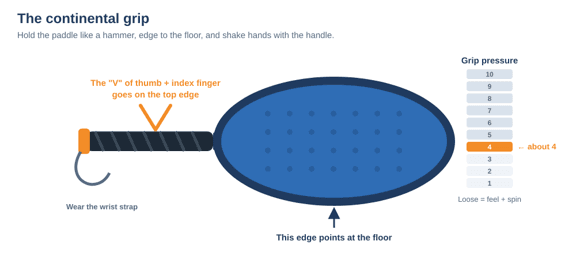
Use the continental grip for almost every shot in padel: serve, forehand, backhand, volley and overhead. You won't need to switch grips mid-rally.
Finding the continental grip
- Hold the paddle with the edge pointing at the floor, like you're holding a hammer.
- Shake hands with the handle so the V between your thumb and index finger sits on the top edge.
- Hold it loosely, about 4 out of 10 on tightness.
- Always wear the wrist strap.
Hitting basics
- Short swings. The court is small and the ball comes back fast. Compact strokes give you control.
- Contact in front. Meet the ball out in front of your body, with your shoulders turned.
- Firm wrist. Swing from the shoulder, not the wrist. This keeps the paddle face steady.
- Slice is your friend. Brushing slightly under the ball keeps it low, which makes it harder for opponents to attack.
- Bend your knees. Many balls stay low after the glass. Get down to them instead of reaching.
4. How to use the walls
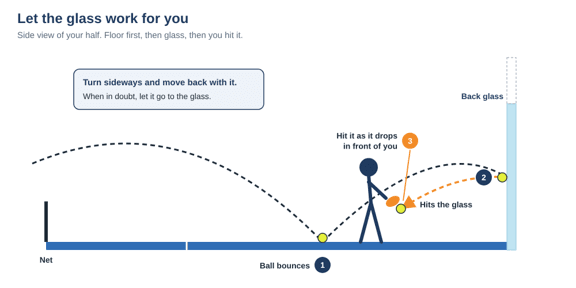
The walls are what make padel different. The key rule: the ball must bounce on the ground first, then it can hit the walls on your side before you return it.
| Situation | What to do |
|---|---|
| Ball heading to the back glass | Don't rush it. Turn sideways, move back with it, and let it come off the glass. Hit it as it drops in front of you. |
| Ball off the side glass | Watch the angle. It will come off toward the middle of the court, so step in that direction. |
| Ball into a corner (back + side) | It hits two walls and slows down. Wait for it, stay low, and hit it gently back. |
| You're in trouble | Hit the ball into your own back glass so it rebounds over the net. Use this only in emergencies. |
| Hitting at opponents | The ball must clear the net and bounce in their court before touching their walls. Hitting their wall directly is your point lost. |
Beginner tip: when in doubt, let it go. Most new players hit the ball too early. Give the glass a chance and you'll have more time than you think.
5. Strategy for beginners
Padel is won at the net and lost by forcing shots. Keep the ball in play and let your opponents make the mistakes.
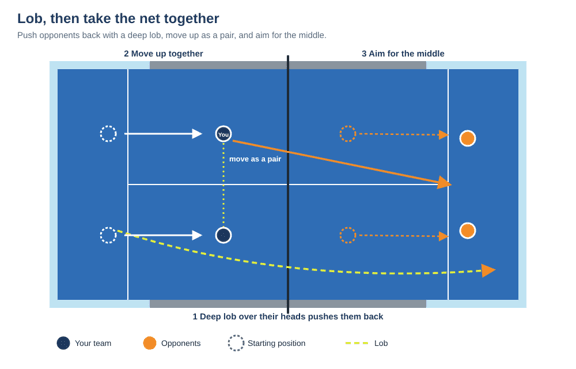
- Get to the net. The team at the net controls the point. After a serve or a good deep shot, move up together.
- Move as a pair. You and your partner should move forward, back and sideways together, like you're connected by a rope. Avoid leaving a gap down the middle.
- Use the lob. When opponents are at the net, a high, deep lob over their heads pushes them back and lets you take the net.
- Aim for the middle. Shots down the center cause confusion over who should take it and cut down your opponents' angles.
- Play slow, not hard. Smashing the ball often sends it off the back glass and right back to your opponents. Low, controlled shots win more points.
- Talk to your partner. Call "mine", "yours" and "switch" so you're never both going for the same ball.
Ready to play?
Learn the scoring, keep your serve low and deep, use the continental grip, let the glass do some of the work, and get to the net with your partner. That's enough to have fun in your first match.
Need a paddle, balls or court shoes? Shop padel gear at Midwest Racquet Sports, or ask our team to help you pick the right paddle for your game.
Shop Padel Gear